Free resources
Start with your
Heart Story.
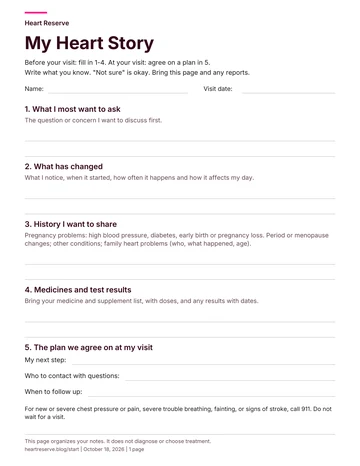
Bring your history, results and questions together for your next healthcare visit.
Build my Heart StoryFree. No account needed.
Find a guide for your question.
More help, when you need it.
Your Heart Story is enough to begin. Open only what is useful to you.
A worksheet for pregnancy, NICU or symptoms
The one-page Heart Story is enough to begin. These optional sheets offer space for a particular concern.
- Describe your symptoms1 page · PDFDownload PDF
- Your health story after the NICU1 page · PDFDownload PDF
- My Pregnancy & Heart Health2 pages · PDFDownload PDF
These optional worksheets organize your notes; they do not diagnose a condition or choose tests or treatment. About clinical review.
Twins, TTTS & NICU support
Information and parent connections for your family, with a place for your own health, too.
- Your own health during and after the NICU
- Dr. Quintero & The Fetal InstituteSpecialist information about twin-to-twin transfusion syndrome (TTTS). (opens in a new tab)
- The TTTS FoundationInformation and parent support groups during and after a complicated twin pregnancy. (opens in a new tab)
- Graham’s FoundationConnect with a parent mentor who understands premature birth and the NICU. (opens in a new tab)
- More about these family resources
Each organization manages its own services. Parent communities offer shared experience; medical questions belong with your care team.
Heart-health guidance from AHA & CardioSmart
Pregnancy complications & your heart
From the American College of Cardiology’s CardioSmart patient resources.
- Read the pregnancy and heart-health guide
- Questions for your care team
- Get CardioSmart’s printable infographic
Everyday heart health
Life’s Essential 8™
The American Heart Association’s eight areas bring daily habits and health measures into one picture. Use them to see what you already know and what you want help with.
Read the American Heart Association’s guideExplore the eight areas and what to ask
Four everyday habits
Eat better
Build meals around vegetables, fruit, whole grains, beans, nuts and lean protein.
Be more active
Work toward 150 minutes of moderate activity a week, such as brisk walking. Start with what you can manage.
Quit tobacco
Avoid smoking, vaping and secondhand smoke. If you use tobacco, ask for help quitting.
Get healthy sleep
Most adults need 7–9 hours a night. Tell your clinician if sleep is regularly difficult.
Four health measures
Manage weight
Ask your care team what a healthy weight and a realistic plan look like for you.
Control cholesterol
Bring your cholesterol results. Ask what the numbers mean and whether you need a plan to lower them.
Manage blood sugar
Ask what your glucose or A1c result means. A1c reflects your average blood sugar over about three months.
Manage blood pressure
Know your readings. Ask about your target and whether checking at home would help.
Which one needs your attention first?
You do not have to work on all eight at once. Bring this question to your visit:
“What should I focus on first, and when should we check my progress?”
Your pregnancy history, family history, menopause, medicines and symptoms also belong in that conversation. Your Heart Story puts those details beside your recent results, so you can discuss the next step together.
Build my Heart StoryPregnant or recently had a baby? Your care team can help you adapt these goals. The AHA also has guidance for pregnancy and resources for women.
Source: American Heart Association. Links and this summary checked October 1, 2026. HEART RESERVE’s explanation is for education and has not had independent clinical review. Linking to the AHA does not imply its endorsement of HEART RESERVE.
For support groups & care teams
Share the one-page handout with families. Its QR code leads to the twin pregnancy guide and appointment worksheet.
Share Heart Story with someone
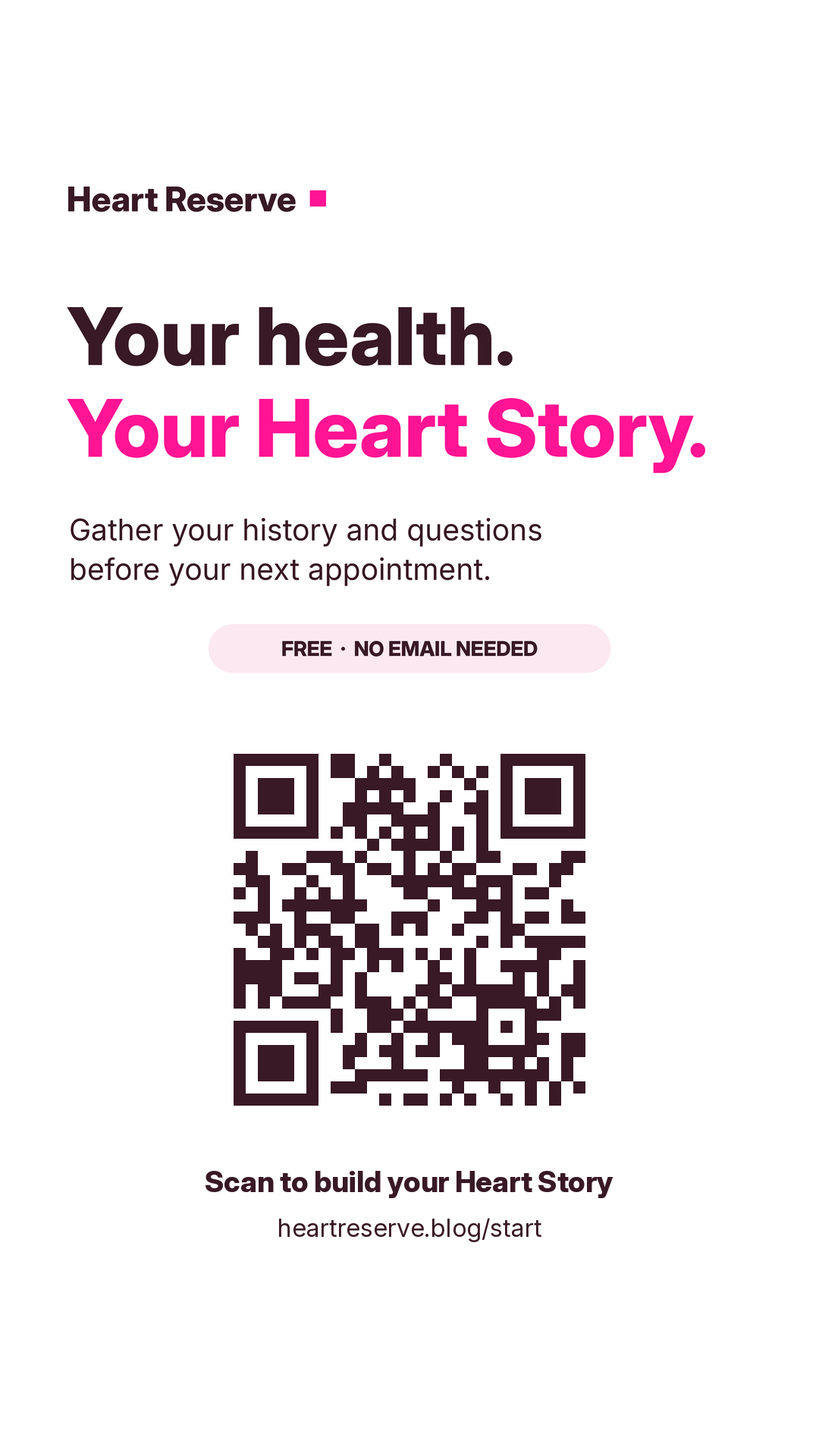
Save this card to share in a story, a group message or with your community.
Download the cardUsing your phone? Tap the card to open the Heart Story.