Women’s healthcare involves coverage, testing, treatment and access to clinicians. With renewed federal attention on women’s health, I’m looking at five companies working in these areas.
As a physician assistant who experienced pregnancy complications, I am interested in how these services come together for the woman receiving care. Who explains her results? Who connects them to her history? Who makes sure she knows what needs follow-up?
In this article
From federal attention to everyday care
The October 19, 2026 executive order directs NIH to establish a Women’s Health Division within 90 days. Its priorities include cardiovascular disease, maternal health, menopause and bringing research into clinical care. The order does not announce funding for these five companies.
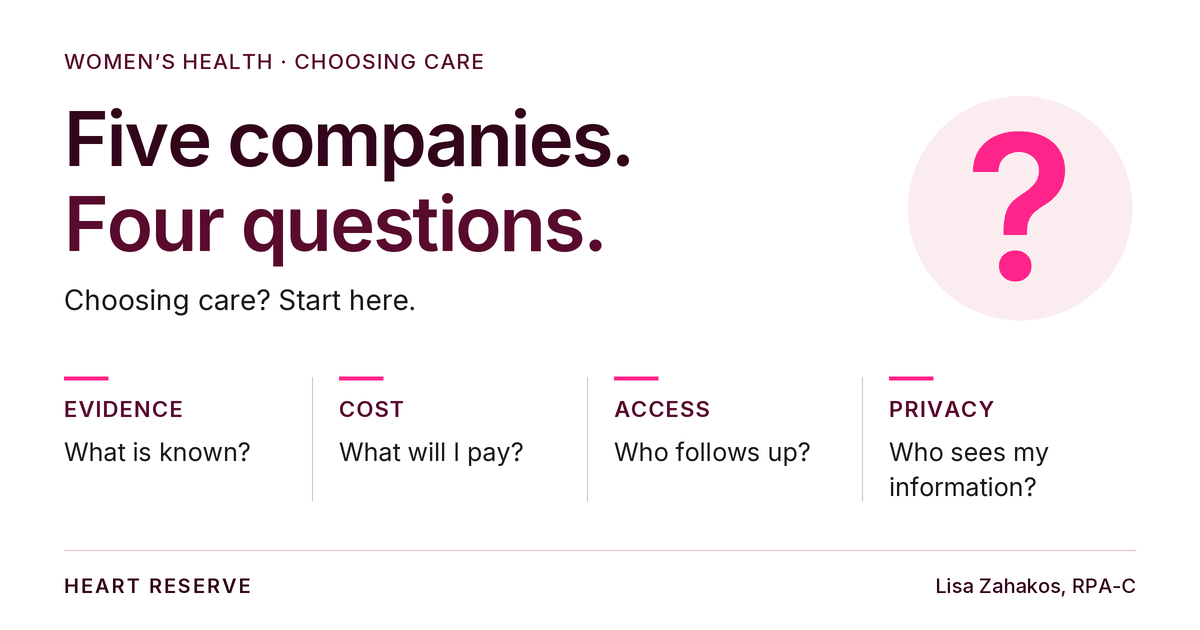
Their work gives us a way to look at the medical details that matter when a woman uses a benefit, receives a result or starts treatment.
Read what the NIH announcement says and what happens next
1. Progyny: care beyond pregnancy
Progyny provides employer benefits for fertility, family building, pregnancy, postpartum care and menopause. What a benefit covers can affect whether a woman can reach the care she needs.
The medicine matters because pregnancy complications can remain relevant years later. Preeclampsia, other high blood pressure disorders of pregnancy and gestational diabetes are associated with a higher risk of cardiovascular disease later in life. That history belongs in the ongoing health record.
An increased risk is a reason to plan follow-up. Ask how obstetric care will connect with primary care, who will review blood pressure and blood sugar, and which visits or services your particular plan covers.
2. Natera: understanding a prenatal screening result
Natera offers prenatal screening and genetic testing, alongside its cancer and organ-health businesses. Its cell-free DNA prenatal screening estimates the chance of certain chromosome conditions.
A screening result is not a diagnosis. A higher-risk result should lead to genetic counseling, ultrasound evaluation and the offer of diagnostic testing, such as chorionic villus sampling (CVS) or amniocentesis. A low-risk result does not rule out every condition.
Before testing, ask what the test can answer. Afterward, ask who will explain the result, what it means for this pregnancy and how any recommended follow-up will be arranged.
3. Myriad Genetics: turning inherited risk into a care plan
Myriad Genetics offers testing for inherited cancer risk, including breast and ovarian cancer. Some harmful changes in genes such as BRCA1 and BRCA2 increase cancer risk. Finding one does not mean a person has cancer or will definitely develop it.
The result may change when breast screening begins, whether breast MRI is recommended, which preventive options deserve discussion and whether relatives should consider testing. There is no effective ovarian cancer screening test, so ovarian risk may require a conversation about other ways to reduce risk.
The useful next step is an explanation of the specific result and a plan based on the gene, personal history and family history. Ask whether genetic counseling is included and who will coordinate that plan.
4. Astellas: menopause treatment and the monitoring it needs
Astellas makes Veozah (fezolinetant), a nonhormonal medicine for moderate to severe hot flashes and night sweats due to menopause. It blocks a signaling pathway in the brain’s temperature-control system without replacing estrogen.
Veozah carries an FDA boxed warning about liver injury. Its prescribing information calls for liver blood tests before treatment, monthly for the first three months, and again at months six and nine.
Knowing how a treatment works also means knowing what monitoring comes with it. Before starting, ask whether it fits your medical history and other medicines, who will order the liver tests and who will review them with you.
5. Hims & Hers: access to menopause care
Hims & Hers Health offers online healthcare, including perimenopause and menopause care through Hers. An online visit can be another way to reach a clinician and discuss symptoms and treatment.
Menopause care should consider symptoms alongside medical history, medicines and individual risks. Midlife is also a useful time to discuss blood pressure, cholesterol and blood sugar, with testing based on what is appropriate for you.
I am interested in how online care connects with the rest of a woman’s healthcare. Ask how prescriptions and results will be shared with your usual clinician, when an in-person assessment is needed and whom to contact if symptoms change.
Bring your history into the conversation
At HEART RESERVE, my focus is helping women bring their pregnancy history, bloodwork and questions into the same healthcare conversation. A useful result or prescription should come with an explanation you understand and a clear next step.
Write down the pregnancy complications you remember, your current medicines, recent results and the questions you want answered. You can use your Heart Story to organize these details, then save or print it for a visit.
Pregnancy history is heart history. This renewed attention is an opportunity to make that history easier to carry into care.
Your next step
Know whom to contact after the result
Add the service, test or medicine you are considering to your Heart Story. Note the history you want the clinician to consider, then ask for the name of the person or team responsible for explaining results and coordinating follow-up.
Before you leave, confirm the next step, when it should happen, and who will follow up.
Free. No account needed. Use your notes with your care team.

Written by
Lisa Zahakos, RPA-C
A physician assistant since 2003, currently working in psychiatry and addiction medicine after earlier work in interventional cardiology and executive and integrative medicine.
Read the editorial and review standardEvidence behind the article
Sources and editorial review
Sources checked:
- Advancing Women’s Health to Improve Outcomes in All Phases of LifeThe White House · Executive order · October 19, 2026
- Executive order to advance women’s health and establish a new NIH divisionU.S. Department of Health and Human Services · Announcement · October 19, 2026
- What we doProgyny · Company service information · Accessed October 20, 2026
- Opportunities in the Postpartum Period to Reduce Cardiovascular Disease Risk After Adverse Pregnancy OutcomesAmerican Heart Association · Scientific statement summary · 2024
- Women’s health genetic testingNatera · Company service information · Accessed October 20, 2026
- Current ACOG guidance on noninvasive prenatal testingAmerican College of Obstetricians and Gynecologists · Accessed October 20, 2026
- Breast cancer and genetic testingMyriad Genetics · Company service information · Accessed October 20, 2026
- BRCA gene changes: cancer risk and genetic testingNational Cancer Institute · Accessed October 20, 2026
- Veozah (fezolinetant) U.S. prescribing informationAstellas Pharma US · Prescribing information · Revised February 2026
- Warning about rare serious liver injury with VeozahU.S. Food and Drug Administration · Drug safety communication · 2024
- Perimenopause and menopause careHers · Company service information · Accessed October 20, 2026
- Hormone therapyThe Menopause Society · Patient education · Accessed October 20, 2026
- Heart healthThe Menopause Society · Patient education · Accessed October 20, 2026
Company pages describe the services offered. The medical explanations draw on the clinical guidance, federal health sources and prescribing information listed above. A company’s inclusion does not establish that its services improve long-term health outcomes.
Independent clinical review is identified only when it has been completed and approved in writing. No external reviewer or organization is implied. Sources do not imply endorsement of HEART RESERVE.