Research is raising the possibility that GLP-1 medicines could lower the risk of some cancers. For women seeing headlines about ovarian, endometrial or breast cancer, the question is understandable: could a medicine prescribed for weight or blood sugar offer another benefit?
The findings are encouraging in some studies and less reassuring in others. We need to look at who was studied, which cancers were counted and what treatment was used for comparison. The heart evidence also matters, because some cardiovascular benefits have already been established in randomized trials.
In this article
What did the review of 78 studies find?
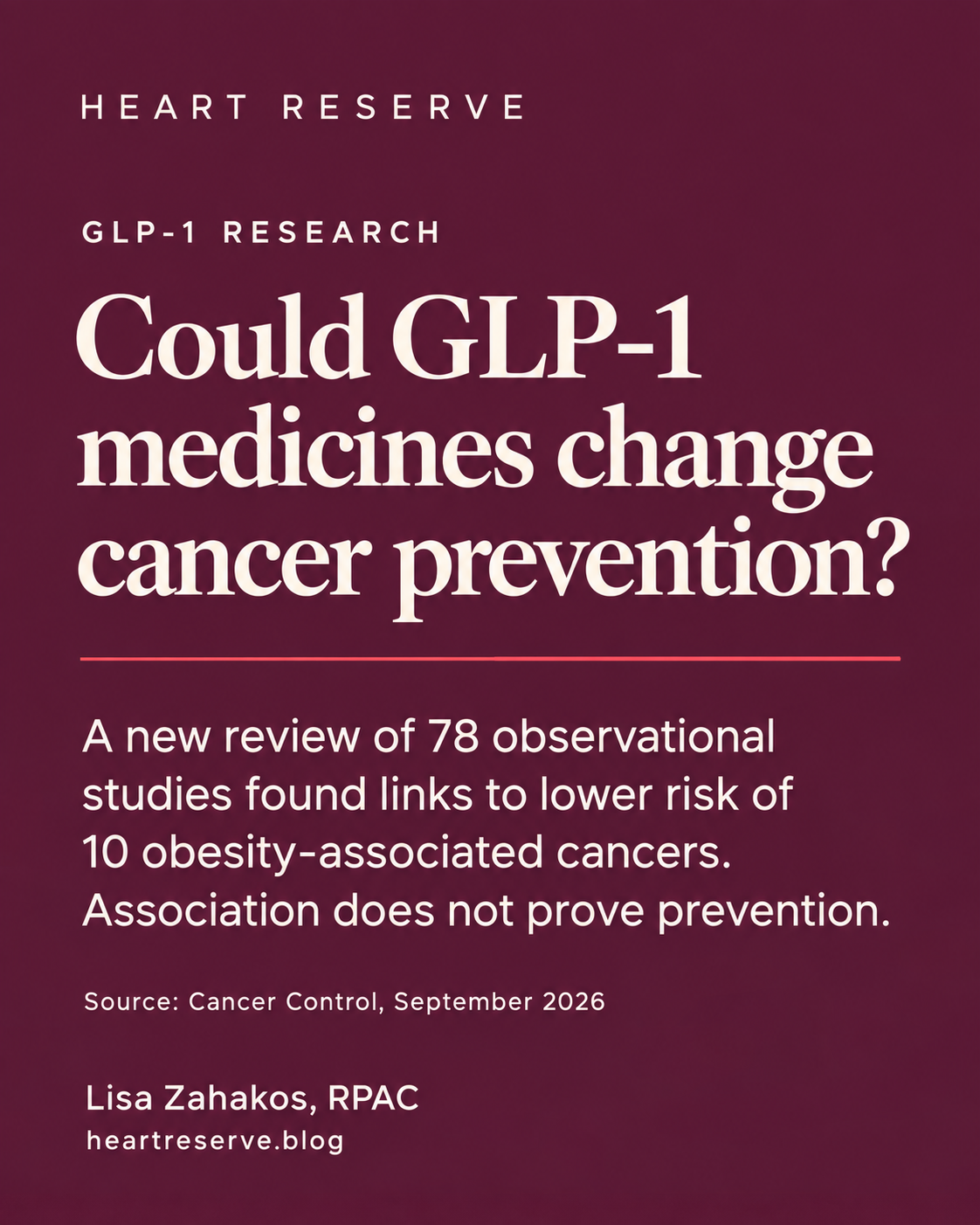
Isha Lalani, Darren R. Brenner and colleagues combined 78 observational studies in a review published September 1, 2026, in Cancer Control. GLP-1 use was associated with lower risk of 10 of the 13 obesity-associated cancers examined, including ovarian, endometrial, colorectal, liver and pancreatic cancer. Endometrial cancer starts in the lining of the uterus.
The findings varied by cancer and by comparison treatment. Several associations were stronger when GLP-1 medicines were compared with insulin; comparisons with other medicines were less consistent. Many of the underlying studies involved people with type 2 diabetes.
These were observations from clinical records, not trials that randomly assigned people to treatment to find out whether cancer could be prevented. Combining many studies increases the amount of information, but it does not remove their shared limitations.
Sources: 1
What do randomized trials show?
Albert Ko, Cho-Han Chiang and colleagues reviewed 48 placebo-controlled randomized trials involving 94,245 participants. Published online in December 2025 and in the February 2026 issue of Annals of Internal Medicine, the review found that GLP-1 medicines probably have little or no effect on thyroid, pancreatic, breast or kidney cancer risk. Evidence for most other cancer types was less certain.
These trials provide a different kind of evidence from medical-record comparisons, but they were not designed primarily to study cancer and follow-up was short. Their findings do not establish cancer prevention or settle the possible effects of many years of treatment.
Sources: 7
Where did the 41% figure come from?
A. H.-C. Hsu, Aparna A. Kamat and colleagues examined adults with obesity who did not have diabetes in the August 2026 issue of Annals of Oncology. They matched 80,899 GLP-1 users with 80,899 people receiving diet or exercise counseling: 161,798 people in total.
Over a median follow-up of two years, GLP-1 use was associated with a 41% lower relative hazard of developing an obesity-associated cancer. Hazard compares how quickly events occur over follow-up. This was not a 41-percentage-point drop in an individual’s chance of cancer, and it was not a finding about every cancer.
Matching made the groups more comparable, but treatment was not assigned at random. The study cannot show that the medicine caused the difference. Two years is also a short period for understanding cancers that can take much longer to develop.
Sources: 2
What about breast cancer?
Elizabeth McDonald, MD, PhD, a breast radiologist at Penn Medicine, and her colleagues reported a separate analysis in June 2026 involving 111,646 women ages 45 to 80 with a body mass index of at least 25 who had undergone breast imaging. In the matched analysis, women with documented GLP-1 prescriptions had about 30% lower odds of a new breast cancer diagnosis.
This was also observational. The analysis did not account for the particular GLP-1 medicine, duration of use, genetic risk factors, or cancer stage and type. Penn described plans for a multisite clinical trial; the published finding itself was not a cancer-prevention trial result.
“Ultimately, we want to find better options to prevent breast cancer,” McDonald said in Penn Medicine’s June 2 announcement. Her comment describes the goal of the research; prevention has not been established by these findings.
Sources: 3
What is the Rutgers breast cancer trial testing?
Coral Omene, MD, PhD, is the principal investigator of an active phase II trial at Rutgers Cancer Institute studying tirzepatide in eligible patients with early hormone receptor-positive, HER2-negative breast cancer during endocrine treatment. Tirzepatide acts on both GIP and GLP-1 receptors. This trial involves people who have already had breast cancer, rather than testing whether it prevents a first diagnosis.
The main outcome is how many participants lose at least 5% of their body weight. Researchers are also following safety, cancer outcomes over three years, and changes in blood pressure, blood sugar, cholesterol and body composition.
Those metabolic measures are relevant to heart health. The trial has not yet established fewer heart attacks or fewer cancer recurrences. Its registry number is NCT06518837; trial details were checked October 4, 2026.
Sources: 4
Why have some studies found higher cancer rates?
Stacey M. Sklepinski, Rozalina G. McCoy and colleagues compared several diabetes treatments in adults with type 2 diabetes and moderate cardiovascular risk in the September 2026 issue of Diabetes Research and Clinical Practice. GLP-1 users had higher overall cancer risk than people receiving some other diabetes medicines. The difference was driven by cancers not associated with obesity; the study found no difference between the drug groups for obesity-associated cancers.
This finding also needs further investigation. It came from an analysis of insurance records and does not prove the medicines caused cancer. It does show why a broad claim that GLP-1s ‘lower cancer risk’ leaves out information patients need.
A comparison with insulin, a comparison with another diabetes medicine and a comparison with lifestyle counseling answer different questions. So do studies of people with diabetes, people without diabetes and people who have already had cancer.
What did the new pancreatic-cancer safety study find?
At the European Association for the Study of Diabetes meeting in September 2026, Anton Pottegård and colleagues presented a registry study including 97,464 semaglutide users with type 2 diabetes in Denmark, Sweden and Norway. Pancreatic-cancer risk was not significantly different from that in matched users of other diabetes medicines.
Average follow-up after a one-year lag was about 1.4–1.9 years. This provides some short-term reassurance, but cannot establish long-term safety or prevention. Novo Nordisk funded the study. These were conference findings; no full journal article was available at the time of the announcement.
Sources: 8
Where is the heart evidence stronger?
For one important group of patients, the cardiovascular benefit of semaglutide is already established. Wegovy is FDA-approved to reduce cardiovascular death, heart attack and stroke in adults with established cardiovascular disease and overweight or obesity.
The randomized trial supporting that indication included more than 17,600 people. A major cardiovascular event occurred in 6.5% of people receiving Wegovy and 8% receiving placebo during the trial. Both groups also received usual cardiovascular care and lifestyle counseling. That is an absolute difference of 1.5 percentage points over the study period.
This is evidence about serious cardiovascular events, beyond a change in weight or blood tests. It applies to the medicine and population studied. It does not establish a cancer-prevention benefit or mean that every GLP-1 medicine has the same evidence.
Sources: 6
What does this mean for your care now?
If you take one of these medicines, ask what benefits have been demonstrated for your medicine in people with a history like yours. The answer may involve blood sugar, weight, cardiovascular disease or another approved use. Possible cancer benefits should be described as a research question.
These findings do not justify starting a GLP-1 solely to prevent cancer, replacing recommended screening, or changing an existing treatment without your prescriber. If you have had breast cancer, bring the question to your oncology team as well.
At HEART RESERVE, the purpose is to make these conversations easier to have. Bring your family history, treatment history and questions into the discussion, so you and your clinician can decide what the evidence means for you.

Written by
Lisa Zahakos, RPA-C
A physician assistant whose clinical practice from 2003–2018 spanned interventional cardiology, executive and integrative medicine, psychiatry and addiction medicine.
Read the editorial and review standardEvidence behind the article
Sources and editorial review
Sources checked:
- Associations Between GLP-1 Receptor Agonists and Cancer Risk: A Systematic Review and Meta-AnalysisLalani and colleagues · Cancer Control · September 1, 2026
- GLP-1 receptor agonist use and cancer risk in obese nondiabetic adultsHsu, Kamat and colleagues · Annals of Oncology · August 2026 issue
- GLP-1 use linked to lower breast cancer incidence in large cohort studyPenn Medicine · Research published in JCO Oncology Practice · June 2, 2026
- Tirzepatide for Weight Loss in Patients with Early-Stage Hormone Receptor Positive/HER2 Negative Breast Cancer · NCT06518837National Cancer Institute · Rutgers Cancer Institute · Trial listing accessed October 4, 2026
- Association of GLP-1 receptor agonists, SGLT 2 inhibitors, DPP-4 inhibitors, and sulfonylureas with incident cancer in type 2 diabetesSklepinski and colleagues · Diabetes Research and Clinical Practice · September 2026 issue
- FDA Approves First Treatment to Reduce Risk of Serious Heart Problems Specifically in Adults with Obesity or OverweightU.S. Food and Drug Administration · March 8, 2024
- Risk for Cancer With Glucagon-Like Peptide-1 Receptor Agonists and Dual Agonists: A Systematic Review and Meta-analysisKo, Chiang and colleagues · Annals of Internal Medicine · Online December 9, 2025 · February 2026 issue
- Regulator-mandated study of semaglutide and pancreatic cancer · EASD oral presentation LBA 35European Association for the Study of Diabetes · September 28, 2026 · Conference findings
The studies described here include medical-record analyses, a review of randomized cancer-outcome data, conference safety findings, an ongoing breast cancer trial and a completed cardiovascular outcomes trial. A trial’s objectives are not its results. Listing a study does not mean HEART RESERVE is involved in it.
The cancer findings differ by population, cancer type, comparator and follow-up. The September review searched studies available through September 17, 2025; it is not a synthesis of every 2026 study.
Independent clinical review is identified only when it has been completed and approved in writing. No external reviewer or organization is implied. Sources do not imply endorsement of HEART RESERVE.